

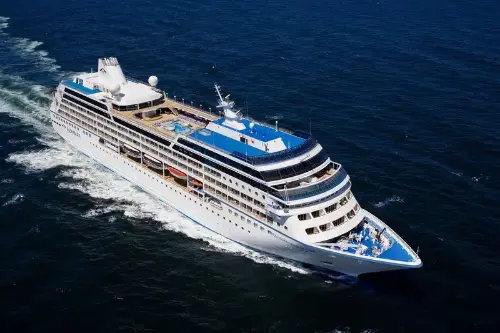
Sea cruise · 16.04.2027 – 30.04.2027 · 14 nights
14 nights, from Incheon
Cabin prices and availabilityRoute and cruise information
Premium- Incheon
- Yeosu
- Busan
- Busan
- Fukuoka
- Kita-Kyushu. Japan
- Hiroshima
- Beppu
- Kochi
- Kobe
- Kobe
- Shimizu
- Yokohama (Tokyo)
- Yokohama (Tokyo)
| Date | Port | Arrival | Departure |
|---|---|---|---|
| 16.04.2027 |
Incheon
Korea
|
— | 22:00 |
| 17.04.2027 |
Day at sea
|
— | — |
| 18.04.2027 |
Yeosu
Korea
|
08:00 | 20:00 |
| 19.04.2027 |
Busan
Korea
|
08:00 | — |
| 20.04.2027 |
Busan
Korea
|
— | 20:00 |
| 21.04.2027 |
Fukuoka
Japan
|
08:00 | 20:00 |
| 22.04.2027 |
Kita-Kyushu. Japan
|
08:00 | 20:00 |
| 23.04.2027 |
Hiroshima
Japan
|
08:00 | 22:00 |
| 24.04.2027 |
Beppu
Japan
|
08:00 | 18:00 |
| 25.04.2027 |
Kochi
India
|
08:00 | 17:00 |
| 26.04.2027 |
Kobe
Japan
|
08:00 | — |
| 27.04.2027 |
Kobe
Japan
|
— | 16:00 |
| 28.04.2027 |
Shimizu
Japan
|
10:30 | 20:00 |
| 29.04.2027 |
Yokohama (Tokyo)
Japan
|
08:00 | — |
| 30.04.2027 |
Yokohama (Tokyo)
Japan
|
09:00 | — |
-
 Day 1: 22:00
Incheon / Korea
Incheon is a port city located on the west coast of South Korea, just 40 kilometers from Seoul. A key transportation hub, Incheon is renowned for its international airport, one of the largest in Asia and an important gateway for travelers heading to South Korea. The city is also known for its picturesque promenades, beautiful beaches, and islands, perfect for leisurely strolls. One of the most popular tourist spots is the Incheon waterfront promenade, with its unique bridge offering breathtaking views of the bay and nearby islands.
In addition, Incheon has a rich cultural history, especially in the Munsoo Island area, where visitors can explore ancient temples and traditional Korean villages. The city gained fame in 1950 due to the Incheon Landing, a pivotal battle of the Korean War. For lovers of modern culture, Incheon hosts exhibitions and festivals, while local restaurants serve the best of Korean cuisine, particularly seafood, which is especially popular due to the city's coastal location.
-
Day 2:
Day at sea / Sea
-
 Day 3: 08:00–20:00
Yeosu / Korea
-
 Day 4: 08:00
Busan / Korea
Busan, formerly known as Pusan and now officially Busan Metropolitan City, is South Korea's second most-populous city after Seoul, with a population of over 3.5 million inhabitants. It is the economic, cultural and educational center of southeastern Korea, with its port—Korea's busiest and the 9th-busiest in the world—only about 120 miles (190 km) from the Japanese islands of Kyushu and Honshu. The surrounding "Southeast Economic Zone" (including Ulsan and South Gyeongsang) is now South Korea's largest industrial area.
-
Day 5: 20:00
Busan / Korea
Busan, formerly known as Pusan and now officially Busan Metropolitan City, is South Korea's second most-populous city after Seoul, with a population of over 3.5 million inhabitants. It is the economic, cultural and educational center of southeastern Korea, with its port—Korea's busiest and the 9th-busiest in the world—only about 120 miles (190 km) from the Japanese islands of Kyushu and Honshu. The surrounding "Southeast Economic Zone" (including Ulsan and South Gyeongsang) is now South Korea's largest industrial area.
-
 Day 6: 08:00–20:00
Fukuoka / Japan
-
Day 7: 08:00–20:00
Kita-Kyushu. Japan
-
 Day 8: 08:00–22:00
Hiroshima / Japan
a city in southwestern Japan, on the southern coast of the island of Honshu; population 1,144,572 (2007). It was the target of the first atom bomb, which was dropped by the US on August 6, 1945, and resulted in the deaths of about one third of the city's population of 300,000. This, with a second attack on Nagasaki three days later, led to Japan's surrender and to the end of World War II.
-
 Day 9: 08:00–18:00
Beppu / Japan
Beppu is a city in Ōita Prefecture on the island of Kyushu, Japan, at the west end of Beppu Bay. As of March 31, 2017, the city had a population of 122,643 and a population density of 980/km2 (2,500/sq mi). The total area is 125.13 km2 (48.31 sq mi). Beppu is famous for its hot springs.
-
 Day 10: 08:00–17:00
Kochi / India
a seaport and naval base on the Malabar Coast of southwestern India, in the state of Kerala; population 254,500 (est. 2009).
-
 Day 11: 08:00
Kobe / Japan
Кобе — один из главных портовых городов Японии, расположен на острове Хонсю. Город является важным транспортным и торговым узлом, а также промышленным центром страны. Кроме этого, Кобе имеет важное религиозное значение и славился «тремя святынями», синтоистскими святилищами Икута, Нагата и Минатогава. К другим достопримечательностям относятся: художественный музей, храм Сума, гробница Минатодзава, парк Соракуэн, старые европейские кварталы улицы Ямамото, портовая башня. Близлежащий остров Авадзи связан с городом мостом Акаси-Кайкё — самым длинным подвесным мостом в мире.
-
Day 12: 16:00
Kobe / Japan
Кобе — один из главных портовых городов Японии, расположен на острове Хонсю. Город является важным транспортным и торговым узлом, а также промышленным центром страны. Кроме этого, Кобе имеет важное религиозное значение и славился «тремя святынями», синтоистскими святилищами Икута, Нагата и Минатогава. К другим достопримечательностям относятся: художественный музей, храм Сума, гробница Минатодзава, парк Соракуэн, старые европейские кварталы улицы Ямамото, портовая башня. Близлежащий остров Авадзи связан с городом мостом Акаси-Кайкё — самым длинным подвесным мостом в мире.
-
 Day 13: 10:30–20:00
Shimizu / Japan
-
 Day 14: 08:00
Yokohama (Tokyo) / Japan
Tokyo, officially Tokyo Metropolis, one of the 47 prefectures of Japan, has served as the Japanese capital since 1869. As of 2014, the Greater Tokyo Arearanked as the most populous metropolitan area in the world. The urban area houses the seat of the Emperor of Japan, of the Japanese government and of the National Diet. Tokyo forms part of the Kantō region on the southeastern side of Japan's main island, Honshu, and includes the Izu Islands and Ogasawara Islands. Tokyo was formerly named Edo when Shōgun Tokugawa Ieyasu made the city his headquarters in 1603. It became the capital after Emperor Meiji moved his seat to the city from Kyoto in 1868; at that time Edo was renamed Tokyo. Tokyo Metropolis formed in 1943 from the merger of the former Tokyo Prefecture and the city of Tokyo. Tokyo is often referred to as a city but is officially known and governed as a "metropolitan prefecture", which differs from and combines elements of a city and a prefecture, a characteristic unique to Tokyo.
The 23 Special Wards of Tokyo were formerly Tokyo City. On July 1, 1943, it merged with Tokyo Prefecture and became Tokyo Metropolis with an additional 26 municipalities in the western part of the prefecture, and the Izu islandsand Ogasawara islands south of Tokyo. The population of the special wards is over 9 million people, with the total population of Tokyo Metropolis exceeding 13.8 million. The prefecture is part of the world's most populous metropolitan area called the Greater Tokyo Area with over 38 million people and the world's largest urban agglomeration economy. As of 2011, Tokyo hosted 51 of the Fortune Global 500 companies, the highest number of any city in the world at that time. Tokyo ranked third (twice) in the International Financial Centres Development Index. The city is home to various television networks such as Fuji TV, Tokyo MX, TV Tokyo, TV Asahi, Nippon Television, NHK and the Tokyo Broadcasting System.
-
Day 15: 09:00
Yokohama (Tokyo) / Japan
Tokyo, officially Tokyo Metropolis, one of the 47 prefectures of Japan, has served as the Japanese capital since 1869. As of 2014, the Greater Tokyo Arearanked as the most populous metropolitan area in the world. The urban area houses the seat of the Emperor of Japan, of the Japanese government and of the National Diet. Tokyo forms part of the Kantō region on the southeastern side of Japan's main island, Honshu, and includes the Izu Islands and Ogasawara Islands. Tokyo was formerly named Edo when Shōgun Tokugawa Ieyasu made the city his headquarters in 1603. It became the capital after Emperor Meiji moved his seat to the city from Kyoto in 1868; at that time Edo was renamed Tokyo. Tokyo Metropolis formed in 1943 from the merger of the former Tokyo Prefecture and the city of Tokyo. Tokyo is often referred to as a city but is officially known and governed as a "metropolitan prefecture", which differs from and combines elements of a city and a prefecture, a characteristic unique to Tokyo.
The 23 Special Wards of Tokyo were formerly Tokyo City. On July 1, 1943, it merged with Tokyo Prefecture and became Tokyo Metropolis with an additional 26 municipalities in the western part of the prefecture, and the Izu islandsand Ogasawara islands south of Tokyo. The population of the special wards is over 9 million people, with the total population of Tokyo Metropolis exceeding 13.8 million. The prefecture is part of the world's most populous metropolitan area called the Greater Tokyo Area with over 38 million people and the world's largest urban agglomeration economy. As of 2011, Tokyo hosted 51 of the Fortune Global 500 companies, the highest number of any city in the world at that time. Tokyo ranked third (twice) in the International Financial Centres Development Index. The city is home to various television networks such as Fuji TV, Tokyo MX, TV Tokyo, TV Asahi, Nippon Television, NHK and the Tokyo Broadcasting System.
Please wait…
Still have a question?
We'll help you choose a cruise and answer your questions.